David Hockney's Pool Paintings as Acts of Visibility and Innovation


David Hockney’s iconic pool paintings, specifically Peter Getting Out of Nick's Pool and A Bigger Splash[1], represent a revolutionary moment in modern art. This paper argues that through these works, Hockney performed a dual act: he crafted a confident, public "propaganda" for a homosexual identity by appropriating and queering classical artistic traditions, while simultaneously conducting a radical formal inquiry into the representation of light, water, and the fleeting moment, thus forever intertwining his personal vision with the iconography of Los Angeles.
From Closet to Californian Sun: The Context of a Rebellion
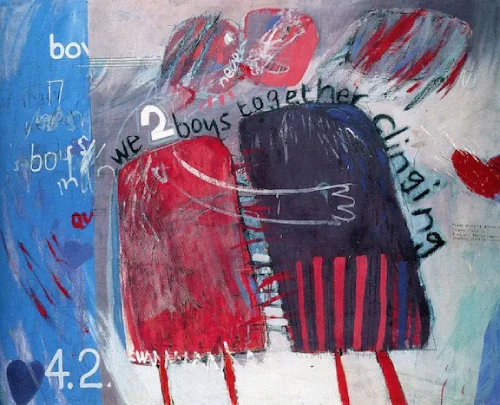
Fig. 1: David Hockney, We Two Boys Together Clinging, 1961, Acrylic on canvas.
David Hockney's artistic journey to Los Angeles was a pilgrimage from repression to liberation. He left a postwar Britain where homosexuality was not only stigmatized but illegal – the Wolfenden Report's recommendations were only partially implemented in 1967, the very year his painting Peter Getting Out of Nick's Pool won the John Moores prize.[2] This legal and social context is not merely a backdrop; it is the essential counterpoint that gives his Californian works their radical charge.[3] As one source notes, "When Hockney entered the Royal College of Art in 1959, a homosexual act between two men was illegal in the UK. It was not until 1967 that this was partially decriminalised. Against this backdrop, Hockney pursued his personal and artistic identity as a young gay man."(Searle, 1966) Hockney’s early work in London, such as We Two Boys Together Clinging (See Fig. 1)[4], which drew from Walt Whitman's poetry, relied on textual codes and abstracted, anxious forms to express desire, a necessary clandestine language.[5] As one curator noted, these early works were "heavily codified" and reflected his desires, such as his infatuation with Cliff Richard, which had to be hidden in plain sight.[6]
California, by contrast, existed in his imagination as a mythologized "promised land," a construct built from Hollywood films and the pages of physique magazines like Physique Pictorial, which provided not only erotic imagery but a visual lexicon of an attainable, sun-drenched life. As Hockney himself recalled, he had "instinctively knew he was going to like it" and upon flying in, seeing "the swimming pools and the houses and everything and the sun, he was more thrilled than [..] ever been in arriving in any city."[7] Upon arrival, the swimming pool crystallized as the ultimate symbol of this new world – an emblem of luxury, leisure, and bodily freedom that was utterly alien to his Northern English, working-class roots. Hockney was acutely aware of the power of this imagery, later stating, “What one must remember about some of these pictures is that they were partly propaganda of something I felt hadn’t been propagandised as a subject: homosexuality.”[8] This term "propaganda" is crucial; it frames his project not as passive expression but as an active, deliberate campaign for visibility. The pool became his primary stage for this campaign, a space where the private gaze could become a public statement. The presence of his lover and muse, Peter Schlesinger[9], further personalized this political act, transforming a general homoeroticism into intimate portraiture and grounding his “propaganda” in a lived, emotional reality. Schlesinger was "the muse and Hockney's beloved," making their personal relationship central to the artistic output.[10]
The Mechanics of the Gaze: Subversion and Formal Mastery in Two Paintings
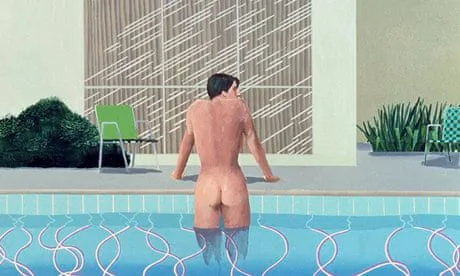
Fig. 2: David Hockney, Peter Getting Out of Nick's Pool ,1966, Acrylic on canvas, Walker Art Gallery, Liverpool/Richard Schmidt.
In Peter Getting Out of Nick's Pool (See Fig. 2), Hockney’s propaganda is executed with serene confidence through a sophisticated queering of art historical tradition. The composition is a direct and subversive homage to the classical Venus Anadyomene motif, in which a goddess is depicted rising from the sea. Hockney replaces the female nude with his male muse, Peter Schlesinger; the concrete pool edge becomes his shell, and the meticulously rendered ripples of water function as the clinging drapery that both reveals and conceals the form.[11] This appropriation is a profound act of artistic rebellion. It takes one of the most canonical, heteronormative subjects in Western art and reclaims it for a confident gay male gaze, compelling the viewer to admire the male body as an object of aesthetic beauty and desire. As one critic noted, the image is "a male version of Titian's Venus Anadyomene or Raphael's Galatea. It's a hymn to perfection and a dream of love."[12] Formally, the painting underscores its own constructed nature. The pose was not captured from life at the pool but was transposed from a Polaroid photograph of Peter leaning against a car.[13] This method highlights Hockney’s process of building an ideal reality from fragments of the real. Furthermore, the raw, unprimed canvas border was a conscious decision by Hockney to “make the picture look more like a painting”[14] a modernist gesture that draws attention to the artifice of the scene and challenges the viewer to engage with it as a composed image, not a stolen glimpse. This technique, as one source notes, was an accommodation to "prevailing fashions amongst avant-garde painters" but one that he would later see as "timid"[15] yet it perfectly serves the painting's purpose of declaring itself as a constructed vision.
The painting’s technical execution is also essential to its meaning. Hockney believed that acrylic paint – still a relatively new medium in the 1960s – perfectly suited his artistic needs. Unlike oil paint, which dries slowly and delays the layering process, acrylic dries quickly, allowing him to work over large areas without waiting. This quality aligned with his technique of applying flat planes of color and later adding precise details. Hockney also felt that the clarity and brightness of acrylic paint better captured the sunlit, sharply contoured suburban landscapes of California, which became central to his visual language. His technical choices thus directly supported his goal of expressing a new Californian reality through a distinctly modern aesthetic.[16]
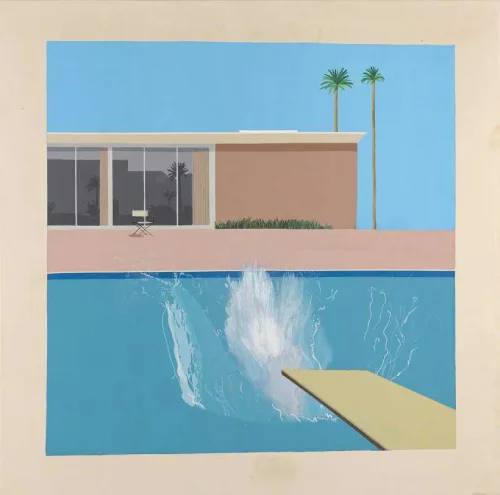
Fig. 3: David Hockney, A Bigger Splash, 1967, Acrylic on canvas.
If Peter operates through overt display, A Bigger Splash (1967, Fig. 3) masterfully explores desire through absence and formal contradiction. The human figure has vanished, leaving only its spectacular, explosive aftermath, the splash as the central subject. This absence creates a powerful narrative suspense and implicates the viewer directly; the empty chair invites us to occupy the position of the witness to this event, placing us within Hockney’s constructed arcadia. The painting’s genius lies in its central formal paradox: Hockney labored for two weeks with small brushes to meticulously render an event that lasts barely two seconds. As Hockney himself explained: “When you photograph a splash, you’re freezing a moment and it becomes something else. I realize that a splash could never be seen this way in real life, it happens too quickly. And I was amused by this, so I painted it in a very, very slow way.”(Tate, 2024) This tension between the instantaneous nature of the subject and the slow, deliberate process of its depiction is a core conceptual thrust of the work.[17]
The splash itself also represents Hockney’s deep engagement with abstraction within a representational framework. The chaotic, expressive white lines are akin to the gestural marks of Abstract Expressionism, yet they are painstakingly controlled and deployed to describe a real-world phenomenon. This abstract energy clashes with and disrupts the rest of the painting’s serene, geometric order – the rigid lines of the modernist building and the flat planes of color. The splash is thus more than water; it is a metaphor for the irrepressible, disruptive force of desire itself breaking through the calm surface of the Californian dream. The source on the technical elements of A Bigger Splash details his process: "To achieve the flat even surface of the sky, the building and the pool Hockney used a paint roller, applying two or three layers of paint so that it was opaque. He then painted the few details, the trees, grass, chair, reflections on the window – and the all important splash – on top of the colour blocks using a small brush."(Tate, 2024) This methodical, almost industrial approach to the background makes the handmade, labor-intensive splash appear even more vibrant and alive.[18]
The Legacy of the Gaze: Hockney's Enduring Influence
The impact of Hockney's pool paintings extends far beyond their initial shock value or art world success. They fundamentally shifted the possibilities for queer representation in art. He moved beyond the angst and coding that characterized much of the work of his contemporaries, like Francis Bacon[19], and instead presented a vision of gay life that was integrated, confident, and bathed in light. This was not about internal struggle but about the external celebration of a visible identity. As one critic notes, his early art is a "homotopia" – a place where desire is free. This vision proved to be incredibly influential, paving the way for later artists to explore queer themes with a similar openness and lack of apology.[20]
Furthermore, Hockney's formal innovations surrounding photography and painting have had a lasting impact. His use of the Polaroid as a source material, his play with the border of the canvas to mimic a photograph's edge, and his lengthy process of translating a photographic moment into paint all explore the complex relationship between these two mediums. He does not simply copy a photo; he uses it as a starting point for a deeper investigation into how we see and represent the world. This intellectual engagement with the mechanics of image-making elevates the paintings beyond mere representation and into a discourse on perception itself. Hockney was interested in the surface of the water, about a very thin film, shimmering two-dimensional. What do you see? This relentless questioning of visual reality is a hallmark of his entire career, and it finds one of its purest and most powerful expressions in these pool paintings.[21]
A Lasting Testament: The Enduring Legacy of an Aquatic Revolution
The legacy of Hockney’s pool paintings is both art historical and cultural. They successfully transcended the gallery to become defining images of an era and a lifestyle, yet their radical political and formal core remains potent. Hockney achieved a remarkable feat: he made homosexuality not just a subject of art, but a stylish, attractive, and critically acclaimed sensibility within the mainstream. He moved queer expression from the margins of coding and angst toward the center of light, beauty, and open desire, using formal innovation as his vehicle. His work from this period is a sustained investigation into the act of seeing itself – questioning how we look, who we look at, and how these acts can be framed within and against tradition. Technically, the paintings are masterclasses in solving the problem of representing the unrepresentable: the shimmer of light on a moving surface, the distortion of a body beneath water, and the freezing of a momentary event.[22]
Ultimately, Hockney’s pool paintings constructed a new, enduring iconography. He transformed the swimming pool from a simple symbol of wealth into a powerful, multifaceted symbol of artistic freedom, queer visibility, and the joyous, complex process of translating life into art. His Californian arcadia, built with acrylic paint and radical vision, remains a potent and promised land in the cultural imagination, a lasting testament to the power of art to create new ways of being and seeing. As he himself discovered, Los Angeles "was the world's most beautiful city" precisely because he had the vision to see it not for what it was, but for what it could represent: a brighter, more open, and beautifully constructed world.[23]
References:
1. David Hockney (1937 UK). Peter Getting Out of Nick's Pool (1966), A Bigger Splash (1967).
2. The John Moores Painting Prize is the UK's most well-known and longest-established painting competition, established in 1957 by philanthropist Sir John Moores to support contemporary British painters.
3. Searle, Ronald. (1966) Peter getting out of Nick's pool. (Accessed: 28 August 2025).
4.We Two Boys Together Clinging (1961)
5. Hughes, Gregory R. (2023) 'David Hockney’s great yes to life', GLQ: A Journal of Lesbian and Gay Studies, 29(4), pp. 621-626. (Accessed: 28 August 2025).
6. Brown, Mark (2013) 'David Hockney: 'I am an artist who happens to be gay, not a gay artist'', The Guardian, 11 October. (Accessed: 28 August 2025).
7. See Ref. 5.
8. See Ref. 3.
9. Peter Schlesinger (1948 US).
10. Searle, Ronald (1966) Peter getting out of Nick's pool. [Drawing]. (Accessed: 28 August 2025).
11. Jones, Jonathan (2013) 'David Hockney proves gay art is not all about sex', The Guardian, 7 October. (Accessed: 28 August 2025).
12. Ibid.
13. The Year Zero (2009) 'Peter getting out of Nick’s pool', The Year Zero, 21 November. (Accessed: 28 August 2025).
14. Hockney, David (1966) Peter getting out of Nick's pool [Photographic print]. (Accessed: 28 August 2025).
15. See Ref. 3.
16. Tate (2024) Understanding David Hockney's A Bigger Splash. (Accessed: 28 August 2025).
17. Ibid.
18. Ibid.
19. Francis Bacon (1909 Ireland- 1992 Spain).
20. Jones, Jonathan (2013) David Hockney: the joy of a truly gay artist. (Accessed: 28 August 2025).
21. See Ref. 10.
22. Sooke, Alastair (2017) The bewitching allure of Hockney's swimming pools. (Accessed: 28 August 2025).
23. See Ref. 5.
Cover Image and Image Sources:
Fig. 1: David Hockney, We Two Boys Together Clinging, 1961. Oil on canvas. Source: Glänta, The Great Yes to Life, Glänta, 2021. (Accessed: 28 August 2025).
Fig. 2: David Hockney, Peter Getting Out of Nick's Pool, 1966. Acrylic on canvas. Walker Art Gallery, Liverpool. Photo: © Richard Schmidt. Source: Jones, J., David Hockney: a great painter of 20th-century gay life*, The Guardian, 2013. (Accessed: 28 August 2025).
Fig. 3: David Hockney, A Bigger Splash, 1967. Acrylic on canvas. © David Hockney. Source: Tate, Understanding David Hockney's A Bigger Splash, 2024. (Accessed: 28 August 2025).
Cover Image: David Hockney, Portrait of an Artist (Pool with Two Figures), 1972. [Acrylic on canvas].(Accessed: 28 August 2025).