Jackson Pollock’s Lavender Mist and the Crisis of Modern Expression



Fig. 1: Jackson Pollock, lavender mist, 1950, oil, enamel and aluminum on canvas, 221 x 299.7 cm (87 x 118 in.)
Abstract Expressionism, a post-war movement rooted in emotional intensity and non-representational form, emerged as a powerful articulation of existential urgency in mid-20th-century America. Artists such as Willem de Kooning[1], Mark Rothko[2], and Franz Kline[3] became synonymous with this movement. Among them, Jackson Pollock[4] (1912–1956) stands as perhaps the most iconoclastic and transformative figure, the one who “broke the ice,” in the words of de Kooning at his funeral.(Giuliano, 2024) Pollock’s revolutionary technique of drip painting, and in particular his seminal work Number 1, Lavender Mist[5](See Fig. 1), both exemplify and subvert the conventions of expressionism. This paper revisits Lavender Mist, both in terms of its creation and its complex legacy, including its fateful rejection by Boston’s Museum of Fine Arts.[6]
From Regionalism to Revolutionary Form
Pollock's trajectory from traditional American regionalism, under the mentorship of Thomas Hart Benton[7], to the vanguard of abstract expressionism is a journey that paralleled the nation's own transformation from Depression-era realism to Cold War abstraction. His early life in Wyoming and California exposed him to Native American art and expansive landscapes, visual and emotional registers that later informed his abstract compositions. His exposure to Native American sandpainting and the vastness of Western landscapes inflected both the flowing gestures and the rhythmic density of his later drip works.[8]
Crucially, his transition from figuration to abstraction was shaped by a deep engagement with Jungian psychology. Between 1938 and 1942, Pollock underwent analysis with Jungian therapists Joseph Henderson and Violet Staub de Laszlo, producing drawings that accessed his unconscious as part of therapy. These works, often overlooked, were later sold piecemeal after being rejected by institutions such as the Museum of Fine Arts, Boston.[9]
A Choreography of Chaos: Lavender Mist and the Drip Period
Lavender Mist, originally titled Number 1, 1950, is a culmination of Pollock's "drip period" (1947–1951), when he pioneered action painting – a term coined by critic Harold Rosenberg[10]. It involved laying raw, unstretched canvas on the floor and using unorthodox tools, sticks, syringes, brushes, and even his hands to pour and splatter industrial enamel paint. This allowed Pollock to physically enter the painting, moving around and across it, turning the act of painting into a performative, immersive process. Standing before Lavender Mist, the viewer is engulfed by a field of tangled lines, varied textures, and subtle hues that shimmer across a monumental canvas of approximately 221 × 300 cm – a vast scale that enables full physical immersion. Its scale alone creates a surrounding visual field that fully envelops the observer, blurring the boundary between the viewer and the canvas.[11] Despite its name, no actual lavender pigment is present. Art critic Clement Greenberg[12], Pollock’s most prominent champion, titled the work for its atmospheric tone, describing it as a “miasma that evokes a shimmering sensation.” A pale mauve tint emerges only through the interaction of layered whites, grays, and pinks amid dense skeins of black and umber.[13]
Pollock’s abandonment of centralized focus in Lavender Mist exemplifies the radical “all-over” painting approach – a canvas without hierarchy in which every mark is equally alive.[14] The painting lacks a focal point, embracing the concept of “all-over” painting – a radical break from Renaissance spatial logic. There is no “center” in Lavender Mist; every inch is equally charged, every gesture equally considered. This rejection of hierarchy and representation invites viewers into an emotional and spatial ambiguity, Pollock's canvas becomes a site of psychological projection.[15]
The Postmodern Sublime: Lavender Mist as Lyotardian Event
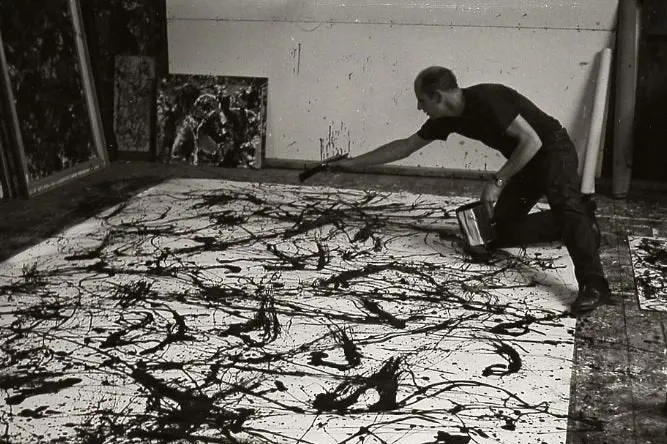
Fig. 2: Jackson Pollock, 1950, working on canvas.
Jean-François Lyotard[16]’s concept of the postmodern sublime, as outlined in the Stanford Encyclopedia of Philosophy, offers a crucial framework for understanding Lavender Mist’s revolutionary impact. For Lyotard, the sublime marks a crisis where art confronts the limits of representation what he terms "the unpresentable in presentation itself."[17] Pollock’s drip painting embodies this crisis:
1. Against Metanarratives: The "all-over" composition of Lavender Mist – with no central hierarchy – mirrors Lyotard’s postmodern "incredulity toward metanarratives." Just as Lyotard rejects totalizing explanations e.g., Marxism, Hegelian progress, Pollock’s canvas refuses a single authoritative reading. Each drip becomes what Lyotard calls a "little narrative" a local, contingent gesture competing across the field.[18]
2. The Sublime as Unpresentable: The painting’s physical traces drips, splatters, handprints exemplify Lyotard’s view that postmodern art "puts forward the unpresentable." These marks are not symbols to be decoded but "events" that disrupt traditional aesthetic judgment. Like Lyotard’s sublime, Lavender Mist "denies itself the solace of good forms," forcing viewers to confront the limits of comprehension.[19]
3. Intensities Over Meanings: Clement Greenberg’s description of Lavender Mist as a "shimmering sensation"[20] aligns with Lyotard’s argument that postmodern art produces "intensities" rather than stable meanings. The painting’s visceral impact – its scale, texture, and kinetic energy – echoes Lyotard’s claim that the sublime "activates differences" beyond linguistic interpretation.[21]
4. The Inhuman and the Body: Pollock’s declaration – "I am the painting" – reflects Lyotard’s notion of the "inhuman," where the artist’s body becomes a site for forces exceeding conscious control gravity, chance, materiality. Lyotard’s "inhuman" names what escapes human mastery precisely what Pollock channels in his physical immersion in the canvas (See Fig. 2). Lavender Mist does not "communicate" in conventional terms but, like Lyotard’s postmodern art, "testifies to the differend" – the gap between what is felt and what can be said.[22]
The Artist's Psyche on Canvas: Pollock's Embodied Abstraction
Pollock famously claimed, "My painting does not come from the easel. I prefer to tack the unstretched canvas to the hard wall or the floor. I need the resistance of a hard surface... I can literally be in the painting." His process, often misunderstood as chaotic or random, was in fact a highly controlled yet deterritorialized act – a dance of intuitive gestures governed by internal rhythm.[23] Gilles Deleuze and Félix Guattari's concept of the Body without Organs (BwO) offers a provocative lens for understanding Pollock's rejection of compositional hierarchy. The BwO – "a non-formed, non-organized, non-stratified body," resonates with Pollock's drip technique, where paint escapes the constraints of brushstroke and figuration, becoming a fluid, anti-organismic field. Like the BwO, Lavender Mist resists formal organization; it is a plane of consistency where lines, splatters, and handprints such as those hauntingly pressed into the upper right corner exist in a state of continuous becoming rather than fixed representation.[24]
Pollock's physical immersion in the canvas—moving around it, dripping from all sides – mirrors Deleuze and Guattari's insistence that desire and art is not about lack as in Freudian or Lacanian psychoanalysis but about productive flux. The painting's "all-over" composition refuses centralized meaning, instead creating a rhizomatic network of marks that defy interpretation. Just as the BwO is "never completely free of stratification" yet seeks lines of flight, Pollock's work oscillates between control and chaos—structured enough to cohere as art, but anarchic enough to disrupt traditional aesthetics. In this sense, Lavender Mist is less a depiction of neurosis as some critics framed it and more a materialization of immanent desire, where the artist's body and the painting's surface merge into a single, uncontained assemblage.[25]
Critics often read this as a symptom of neurosis and his intense physical engagement with his work has been interpreted as both catharsis and confrontation. Indeed, Lavender Mist contains his handprints in the upper right – a haunting echo of prehistoric cave paintings, symbolizing a primal need to mark territory or self.[26] This physical imprint is less an accidental flourish and more a deliberate assertion of presence – his own body inscribed onto the painting as both subject and medium.[27]
Feminist Critique and Phallic Symbolism in Pollock’s Work
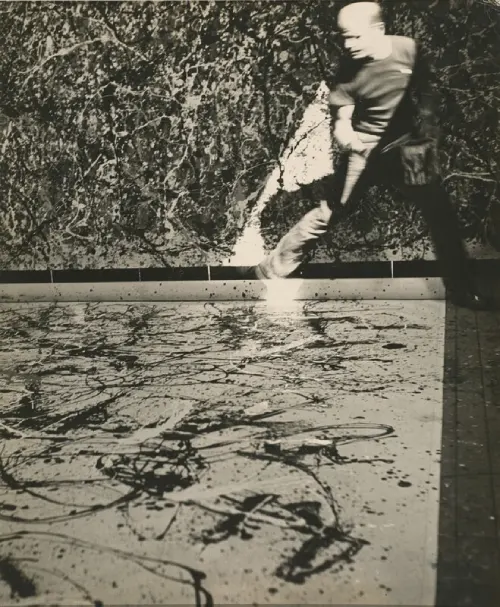
Fig. 3: Hans Namuth, Jackson Pollock, 1950, gelatin silver print, 47.5 x 39.3 cm (18 11/16 x 15 1/2 in).
Feminist art critics have challenged the masculinized narrative of Abstract Expressionism, particularly in the case of Jackson Pollock. The movement, once hailed as a pure and autonomous form of expression, has been shown to reinforce patriarchal ideals and phallocentric symbolism. Pollock’s drip technique celebrated as spontaneous and expressive has been interpreted as a form of phallic mastery, where the gesture itself is linked to masculine sexuality, power, and control. Critics such as Marcia Brennan argue that Pollock’s paintings were described in language tied to aggressive virility “volcanic,” “violent,” reinforcing myths of male artistic genius. The physicality of Pollock’s practice captured famously in Hans Namuth[28]’s photographs positioned his male body as central to the artwork (Fig. 3). This created a contradiction: Abstract Expressionism promoted disembodied artistic autonomy while simultaneously idealizing a gendered, masculine subjectivity. Women artists were excluded or marginalized, and when included e.g., Helen Frankenthaler[29], their work was often dismissed as "feminine," "soft," or "pretty" coded negatively in contrast to the "vigorous" and "heroic" gestures attributed to men. Thus, feminist critics argue that Modernist abstraction perpetuated gendered hierarchies, excluding female subjectivity and reducing them to the “other” of male creativity.[30]
Masculinity and Ambiguity: Gender and Sexuality in Jackson Pollock’s Lavender Mist
Jackson Pollock’s Lavender Mist embodies many key features of Abstract Expressionism’s performative and masculine identity. The vigorous drip technique and large scale create a physical, almost macho spectacle, highlighting masculine energy through bold, sweeping gestures that suggest power and control. These characteristics align with the notion that Abstract Expressionism expresses a masculine subjectivity rooted in social constructs of strength and dominance. However, the use of soft, muted colors such as lavender – a color traditionally associated with femininity introduces an intriguing tension within the painting. This subtle infusion of ‘feminine’ hues challenges the otherwise overt masculine symbolism of the work, suggesting a blurring or complexity in the constructed boundaries of gender and sexuality. Rather than solely asserting a phallic or virile identity, Lavender Mist seems to negotiate between masculine power and delicate femininity, inviting interpretations of sexuality that are more fluid and ambiguous. In this way, Lavender Mist can be read not just as a performance of masculine energy, but also as a site where gendered symbolism intersects and overlaps. The interplay of masculine gestures with traditionally feminine color choices destabilizes rigid gender roles, opening a space for a more nuanced understanding of sexuality within Abstract Expressionism.[31]
Institutional Blindness: The MFA’s Missed Opportunity
The painting’s posthumous fame casts a long shadow on its early reception. When Lavender Mist was offered to the Museum of Fine Arts, Boston in the 1970s for under USD 1 million, curator Kenworth Moffett, an appointee of formalist trustee Lewis Cabot, enthusiastically arranged for its acquisition. However, Director Merrill Rueppel raised conservation concerns, and Chief Conservator William Young admitted he had no idea how to preserve such an unconventional surface. The trustees rejected the purchase. Weeks later, the National Gallery of Art in Washington, D.C., acquired it without hesitation. Today, it stands as a cornerstone of their collection.[32]
The Aftermath and Legacy
Lavender Mist represents the apex of American abstraction, a painting in which spontaneity and control are suspended in perfect tension. It influenced not only the Color Field painters such as Helen Frankenthaler, whose Mountains and Sea lies nearby at the National Gallery but also the trajectory of global abstraction. Frankenthaler’s soak-stain technique visible in works like Mountains and Sea directly extends Pollock’s commitment to dissolving the boundary between paint and surface.[33] Pollock’s canvases, through their scale, density, and defiance, became battlegrounds of modern art criticism loved by Greenberg, loathed by traditionalists, and mystified by many. The Life magazine headline from 1949, “Is he the greatest living painter in the United States?” posed a question that continues to spark debate. But there is no denying the singularity of Pollock’s achievement.[34]
The Echo of a Missed Masterpiece
Lavender Mist is not merely a painting. It is a record of gesture, psyche, and vision – a modern epic inscribed in enamel and movement. Its absence from the MFA is a loss deeply felt—a reminder of how institutional hesitation can deprive audiences of access to artistic revolution. In the dynamic swirls of Pollock’s canvas lies not only the essence of Abstract Expressionism but also a warning to curators and museums: vision requires risk.[35]
References:
1. Willem de Kooning (1904 Netherlands - 1997 US).
2. Mark Rothko (1903 Latvia - 1970 US).
3. Franz Kline (1910 US - 1962 US).
4. Jackson Pollock (1912 US – 1956 US).
5. Number 1, Lavender Mist, 1950.
6. Giuliano, Charles. (2024) One That Got Away from the MFA. GiulianoBooks. Available at: https://giulianobooks.com/pollocks-masterpiece-lavender-mist/ (Accessed: 18 August 2025).
7. Thomas Hart Benton (1889 US – 1975 US).
8. Altenew. (no date) Into the creative mind of Jackson Pollock: his art, style and story. [Online]. (Accessed: 18 August 2025).
9. See Ref. 6.
10. Harold Rosenberg (1906 US – 1978 US).
11. Jackson Pollock.com (no date) Lavender Mist. (Accessed: 18 August 2025).
12. Clement Greenberg (1909 US – 1994 US).
13. See Ref. 6.
14. Matthew Roche (2009) ‘An Analysis: No. 1 (Lavender Mist)’, Metamorphosis: A Landscape. (Accessed: 18 August 2025).
15. Artchive (no date) Lavender Mist Number 1, 1950. (Accessed: 17 August 2025).
16. Jean-François Lyotard (1924 France – 1998 France).
17. Gratton, Peter. (2018) Jean‑François Lyotard. In: The Stanford Encyclopedia of Philosophy (Summer 2018 edn). (Accessed: 18 August 2025).
18. Ibid.
19. Ibid.
20. See Ref. 6.
21. See Ref. 16.
22. Ibid.
23. See Ref. 6.
24. Deleuze Dictionary. (n.d.). Body without organs. [Accessed 18 August 2025].
25. Ibid.
26. Sai.msu.su (no date) Lavender Mist by Jackson Pollock. (Accessed: 18 August 2025).
27. See Ref. 14.
28. Hans Namuth (1915 Germany – 1990 US).
29. Helen Frankenthaler (1928 US – 2011 US).
30. The problematic status of abstraction for women’s painting (no date) In: Writing//painting; l’écriture féminine and difference in the making. (Accessed: 18 August 2025).
31. Oh, my (he)ART. (2016) Gender and Art. (Accessed: 16 August 2025).
32. See Ref. 6.
33. See Ref. 8.
34. See Ref. 14.
35. See Ref. 6.
Cover Image Source:
Jackson‑Pollock.org. (no date) Lavender Mist. Available at: https://www.jackson‑pollock.org/lavender‑mist.jsp (Accessed: 18 August 2025).
Image Sources:
Fig. 1: National Gallery of Art. (no date) Jackson Pollock, Number 1, 1950 (Lavender Mist). (Accessed: 18August 2025).
Fig. 2: Mode Vintage. (no date) Jackson Pollock Influence in «Incontestée Sur La Mode Vintage et l’Art Contemporain». (Accessed: 18 August 2025).
Fig. 3: National Gallery of Art. (no date) Hans Namuth. (Accessed: 18 August 2025).